
Fat Tire & Off Road Electric Bikes
UL Certified Safe
Tested to the highest standards
Free Shipping
Every order, no minimums
Free Pro Assembly
Built by a local bike shop
2-Year Warranty
We've got you covered
Dirwin fat tire and offroad e-bikes are built to go where paved roads end. With 4-inch fat tires, a 750W motor, and a rugged frame engineered for sand, snow, gravel, and singletrack, these models turn any trail into your playground. Long-range batteries deliver 50 to 120 miles on a single charge, and UL 2271 and UL 2849 safety certification means you can push the limits with confidence. Whether you're hunting, bikepacking, or exploring weekend backcountry, this lineup handles it.
Read more Read less
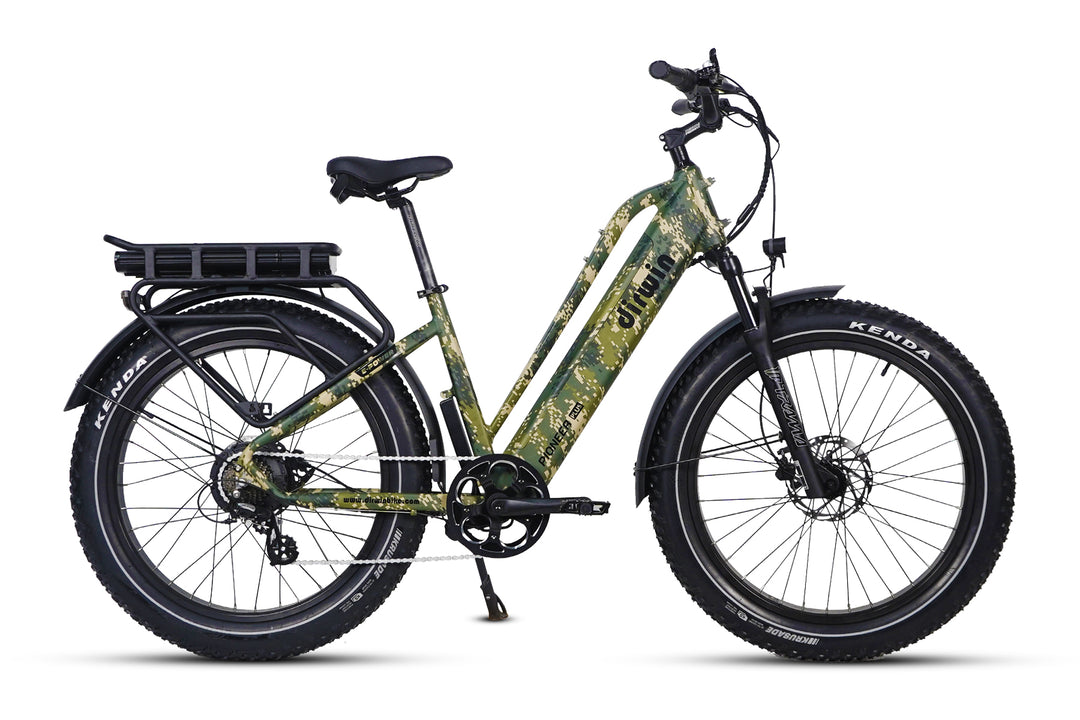
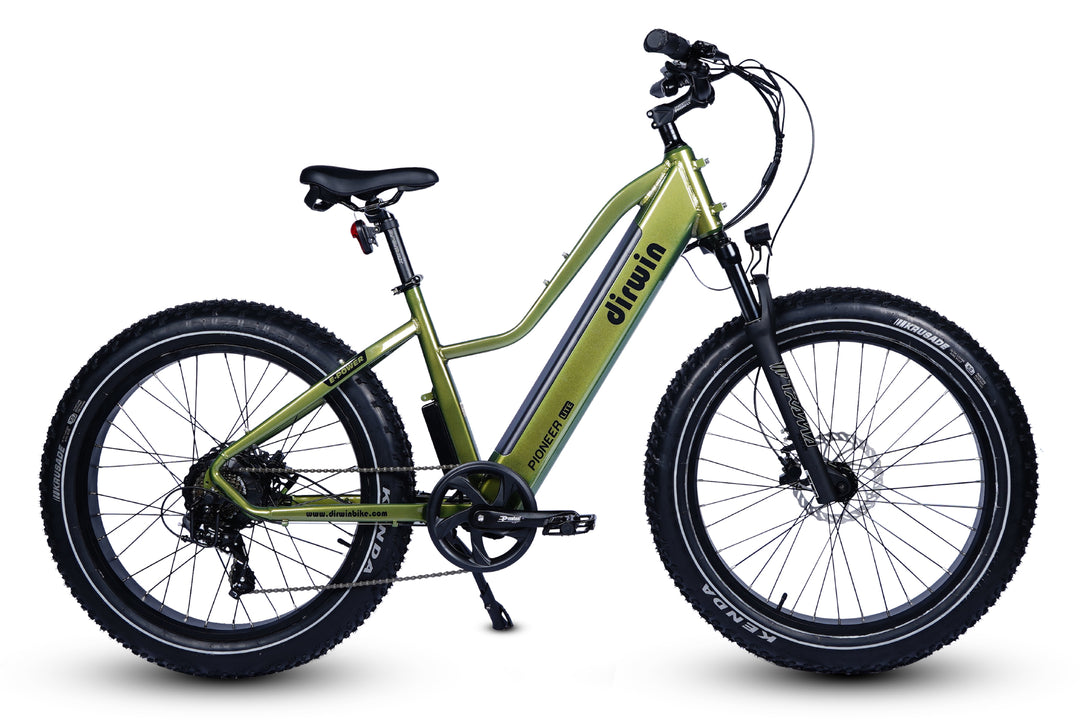
Dirwin fat tire electric bikes are built to ride where pavement ends. Every model in the Pioneer series runs on 26" x 4.0" puncture-resistant Kenda tires, a 750W Bafang rear hub motor, and hydraulic disc brakes designed for dirt, gravel, sand, snow, and steep terrain. Whether you are riding backcountry trails, exploring forest roads, or hauling gear across rough ground, these are all-terrain electric bikes built to handle it.
Three models. One platform. Choose the Pioneer that fits how you ride.
What Makes a Fat Tire Ebike Different?
A fat tire ebike uses wide, high-volume tires (typically 4 inches or wider) that create a larger contact patch with the ground. That extra surface area translates directly into better traction, more stability, and a smoother ride over uneven surfaces. On a standard ebike with 2-inch tires, loose gravel or wet grass can cause wheel slip. A fat tire electric bike rolls over the same terrain with confidence.
The wider tire profile also acts as natural suspension. Fat tires absorb bumps, roots, and rocks that would jar a narrower tire, which means less fatigue on longer rides and more control at lower tire pressures. This is why fat tire ebikes have become the go-to choice for riders who spend time on unpaved surfaces, whether that means forest trails, beach sand, or snowy backroads.
All Dirwin Pioneer models use 26" x 4.0" Kenda tires with deep, aggressive tread patterns. These are not thin-walled recreational tires. They are puncture-resistant, built for loaded riding, and designed to maintain grip in conditions where standard ebike tires would struggle.
Dirwin Pioneer Series: Three Off-Road Ebikes Compared
Choosing between the Pioneer 2, Pioneer Plus, and Pioneer Lite comes down to how far you ride, how much you carry, and what features matter most. Here is a direct comparison.
Pioneer 2 -- Maximum Range and Capacity
The Pioneer 2 is Dirwin's most advanced fat tire electric bike. It carries the largest single battery in the lineup (48V 30Ah), delivering 90 to 120 miles of range per charge. Total payload capacity is 450 lbs, the highest of any Dirwin two-wheel model. The reinforced rear rack supports up to 250 lbs on its own, making it capable of carrying a passenger with the optional bench seat kit. Additional features include seat post suspension, a 10-speed drivetrain, and a deeper step-through frame for easier mounting.
- Battery: 48V 30Ah (1,440 Wh)
- Range: 90 to 120 miles
- Payload: 450 lbs total, 250 lb rear rack
- Drivetrain: 10-speed
- Suspension: Hydraulic fork + seat post suspension
- Starting at: $2,299
Best for: Long-distance off-road riding, heavy cargo hauling, two-up riding with a passenger, and riders who want the most capable platform available.
Pioneer Plus -- Dual Battery, Extended Range
The Pioneer Plus uses a dual-battery system (48V 23.4Ah combined) to reach 60 to 90 miles per charge. It includes Dirwin's 2-in-1 torque and cadence sensor, which lets you switch assist modes on the fly. Torque mode responds to pedal pressure for natural-feeling climbs. Cadence mode provides steady output for cruising. Payload capacity is 350 lbs, and the bike ships with a rear rack and fenders included.
- Battery: 48V 23.4Ah dual batteries (13Ah + 10.4Ah)
- Range: 60 to 90 miles
- Payload: 350 lbs total
- Drivetrain: 7-speed Shimano
- Suspension: Hydraulic fork
- Starting at: $1,999
Best for: Riders who want extended range with dual batteries, flexible assist modes for mixed terrain, and strong all-around off-road performance.
Pioneer Lite -- Lightweight and Budget-Friendly
The Pioneer Lite strips things down to essentials. A single 48V 13Ah battery provides 30 to 50 miles of range. The bike is lighter than the other Pioneer models, easier to load onto a vehicle, and priced under $1,500. It still runs the same 750W Bafang motor, 26" x 4.0" fat tires, and hydraulic disc brakes found across the Pioneer series, so off-road capability does not take a hit.
- Battery: 48V 13Ah (624 Wh)
- Range: 30 to 50 miles
- Payload: 350 lbs total
- Drivetrain: 7-speed Shimano
- Suspension: Hydraulic fork
- Starting at: $1,499
Best for: Riders on a budget, shorter off-road trips, and anyone who values a lighter bike that is easy to transport.
Quick Comparison Table
| Feature | Pioneer 2 | Pioneer Plus | Pioneer Lite |
|---|---|---|---|
| Motor | 750W (1000W peak) | 750W (1000W peak) | 750W |
| Battery | 48V 30Ah | 48V 23.4Ah (dual) | 48V 13Ah |
| Range | 90-120 mi | 60-90 mi | 30-50 mi |
| Max Speed | 28 MPH | 28 MPH | 25 MPH |
| Payload | 450 lbs | 350 lbs | 350 lbs |
| Rear Rack | 250 lb rated | Included | Not included |
| Suspension | Fork + seat post | Fork | Fork |
| Drivetrain | 10-speed | 7-speed Shimano | 7-speed Shimano |
| Sensor | Torque & Cadence | Torque & Cadence | Cadence |
| Brakes | 180mm hydraulic | 180mm hydraulic | 180mm hydraulic |
| Tires | 26" x 4.0" Kenda | 26" x 4.0" Kenda | 26" x 4.0" Kenda |
| Water Resistance | IPX5 | IPX5 | IPX5 |
| UL Certified | Yes | Yes | Yes |
| Price | From $2,299 | From $1,999 | From $1,499 |
How to Choose the Best Fat Tire Ebike for Your Riding Style
Not every off-road electric bike needs to be the most expensive one. The right fat tire ebike depends on where you ride, how far you go, and what you need to carry.
Choose range first. If your typical rides are under 30 miles round trip, the Pioneer Lite has plenty of battery. If you regularly ride 40 to 70 miles or want a buffer for hilly terrain, the Pioneer Plus with dual batteries gives you that cushion. For all-day adventures or riders who do not want to think about battery life, the Pioneer 2 and its 120-mile range removes range anxiety entirely.
Think about cargo and payload. All three Pioneers handle a rider and some gear without issue. But if you regularly carry heavy loads, need a reinforced rear rack, or want the option to carry a passenger, the Pioneer 2's 450 lb capacity and 250 lb rear rack set it apart. The Plus and Lite both handle 350 lbs total, which covers most solo riders and moderate gear.
Consider the terrain. Every Pioneer model shares the same 750W motor, fat tires, and hydraulic brakes, so fundamental off-road ability is consistent across the lineup. Where the models differ is in how they handle sustained punishment. The Pioneer 2's seat post suspension and 10-speed drivetrain give you more comfort and gearing options on long, technical rides. The Lite and Plus rely on a hydraulic fork and 7-speed Shimano, which works well for most trail conditions.
Budget matters. At $1,499, the Pioneer Lite is one of the best values in the fat tire ebike market. You get the same core platform (motor, tires, brakes) as the more expensive models without paying for features you may not need. If budget is tight, start with the Lite and upgrade later.
What to Look for in an Off-Road Electric Bike
If you are comparing fat tire electric bikes across brands, these are the specs and features that actually matter for off-road performance.
Motor power and torque. A 750W motor is the legal maximum for ebikes in most U.S. states and provides enough power for steep grades and loaded riding. Pay attention to torque ratings (measured in Nm) in addition to wattage. Higher torque means better hill climbing. The Dirwin Pioneer series delivers 80Nm of torque, which handles grades up to 20%.
Battery capacity, not just range claims. Range estimates vary widely across brands because testing conditions differ. Instead of relying on advertised range alone, look at the battery's watt-hour (Wh) rating. Higher Wh means more stored energy. The Pioneer 2's 1,440 Wh battery is among the largest in the fat tire ebike category, which is why its range tops out at 120 miles.
Tire width and tread pattern. For genuine off-road use, 4-inch tires with aggressive tread are the baseline. Some budget fat tire ebikes use smooth or semi-smooth treads that look like fat tires but offer limited grip on loose or wet surfaces. All Pioneer models use deep-tread Kenda tires built for dirt, mud, and gravel.
Braking system. Mechanical disc brakes are common on cheaper ebikes but lack the stopping power needed for heavy, fast off-road riding. Hydraulic disc brakes provide consistent, powerful braking regardless of weather or trail conditions. Every Dirwin fat tire ebike uses 180mm hydraulic disc brakes.
Frame and build quality. UL certification (UL 2849 for the electrical system, UL 2271 for the battery) means the bike has been independently tested for electrical safety. Not all ebike brands carry UL certification. Every Dirwin ebike is UL certified.
Water resistance. If you ride in rain, creek crossings, or wet grass, check for an IPX rating. IPX5 (the rating on all Pioneer models) means the bike handles water jets from any direction, so riding in rain or through puddles is not a concern.
Where to Ride a Fat Tire Electric Bike
Fat tire ebikes open up terrain that standard electric bikes cannot handle. Here are some of the most popular uses.
Trails and fire roads. Forest service roads, ATV trails, and singletrack that would be rough on a standard ebike become manageable with fat tires and suspension. The extra traction and stability let you ride confidently over roots, rocks, and loose dirt.
Sand and beaches. Fat tires at lower pressures (around 8 to 12 PSI) float on sand instead of digging in. Coastal riders and beachgoers use fat tire ebikes for access to areas where cars and standard bikes cannot go.
Snow and ice. The same low-pressure advantage that works on sand also applies to snow. Fat tire ebikes have become popular with winter riders who want to keep cycling year-round. Studded tire options are also available for icy conditions.
Gravel and dirt roads. Rural riders, farm use, and property access over unpaved roads are natural fits for fat tire ebikes. The combination of motor assist and wide tires makes long gravel roads comfortable instead of exhausting.
Camping and overlanding. Fat tire ebikes pair well with truck beds, RVs, and campsites. Ride from camp to explore the surrounding area without starting a vehicle.
Every Dirwin Fat Tire Ebike Includes
All Pioneer models share a common set of features and benefits:
- 750W Bafang rear hub motor with responsive pedal assist and throttle control
- 26" x 4.0" puncture-resistant Kenda fat tires with deep aggressive tread
- 180mm hydraulic disc brakes for reliable stopping power in any condition
- Hydraulic suspension fork to absorb trail impacts
- IPX5 water resistance for confident riding in rain, mud, or snow
- UL certification (UL 2849 electrical system, UL 2271 battery)
- LCD display with USB charging for on-the-go device power
- Front and rear LED lights for low-light visibility
- Free shipping within the continental United States
- Free professional assembly at a local bike shop
- 2-year warranty (12 months standard + 12 months with registration)
Frequently Asked Questions
A fat tire electric bike is a battery-powered bicycle with oversized tires, typically 4 inches wide or more. The wider tires provide better traction and stability on loose, uneven, or soft surfaces like dirt, sand, gravel, and snow. Combined with a powerful electric motor, a fat tire ebike lets you ride off-road terrain that would be difficult or impossible on a standard bicycle or narrow-tire ebike.
Yes. Fat tire ebikes are specifically designed for off-road conditions. The wide tires grip loose surfaces, the high-volume air chamber absorbs bumps and vibrations, and the motor provides power for climbing hills and riding through soft terrain. Dirwin Pioneer models add hydraulic suspension, hydraulic brakes, and puncture-resistant tires to handle demanding trails.
Range depends on the battery size, terrain, rider weight, and assist level. The Dirwin Pioneer Lite delivers 30 to 50 miles per charge. The Pioneer Plus reaches 60 to 90 miles with its dual battery system. The Pioneer 2 offers the longest range at 90 to 120 miles on a single charge. Real-world range on hilly off-road terrain will typically fall toward the lower end of these estimates.
The Dirwin Pioneer Lite is a strong starting point for new riders. It uses the same 750W motor, fat tires, and hydraulic brakes as the more expensive Pioneer models but at a lower price point ($1,499). The lighter weight also makes it easier to handle for riders still building confidence on trails.
Absolutely. Fat tire electric bikes ride smoothly on paved roads and paths. The wider tires do create slightly more rolling resistance than thin road tires, so you may use a bit more battery on long paved rides. But most riders find the comfort and stability of fat tires worth the tradeoff, especially if their route includes both pavement and unpaved sections.
In most U.S. states, electric bikes classified as Class 1, Class 2, or Class 3 do not require a license, registration, or insurance for on-road and approved trail use. Dirwin ebikes can be adjusted between Class 1, Class 2, and Class 3 using the standard bike settings. Trail access rules vary by location, so check your local regulations for specific off-road areas.
Yes. Every Dirwin Pioneer series ebike is UL certified, including UL 2271 for the battery and UL 2849 for the electrical system. UL certification means the bike has been independently tested for electrical and fire safety by Underwriters Laboratories.
The Pioneer Lite and Pioneer Plus each support a total payload of 350 lbs (rider + gear). The Pioneer 2 supports up to 450 lbs total, with a rear rack rated for 250 lbs. All three models are recommended for riders between 5'3" and 6'4" in height.
A cadence sensor provides electric assist whenever you pedal, regardless of how hard you push. A torque sensor measures how much force you apply to the pedals and adjusts motor output to match, creating a more natural riding feel. The Pioneer 2 and Pioneer Plus include a 2-in-1 torque and cadence sensor so you can switch between modes. The Pioneer Lite uses a cadence sensor.
Yes. Dirwin Pioneer models are rated to climb grades up to 20%, which is extremely steep. Most paved roads max out around 6% grade. The combination of a 750W motor, 80Nm of torque, and a multi-speed drivetrain gives you the power and gearing options to climb steep dirt hills even while carrying cargo.